New Release — Ebook · EPUB + PDF
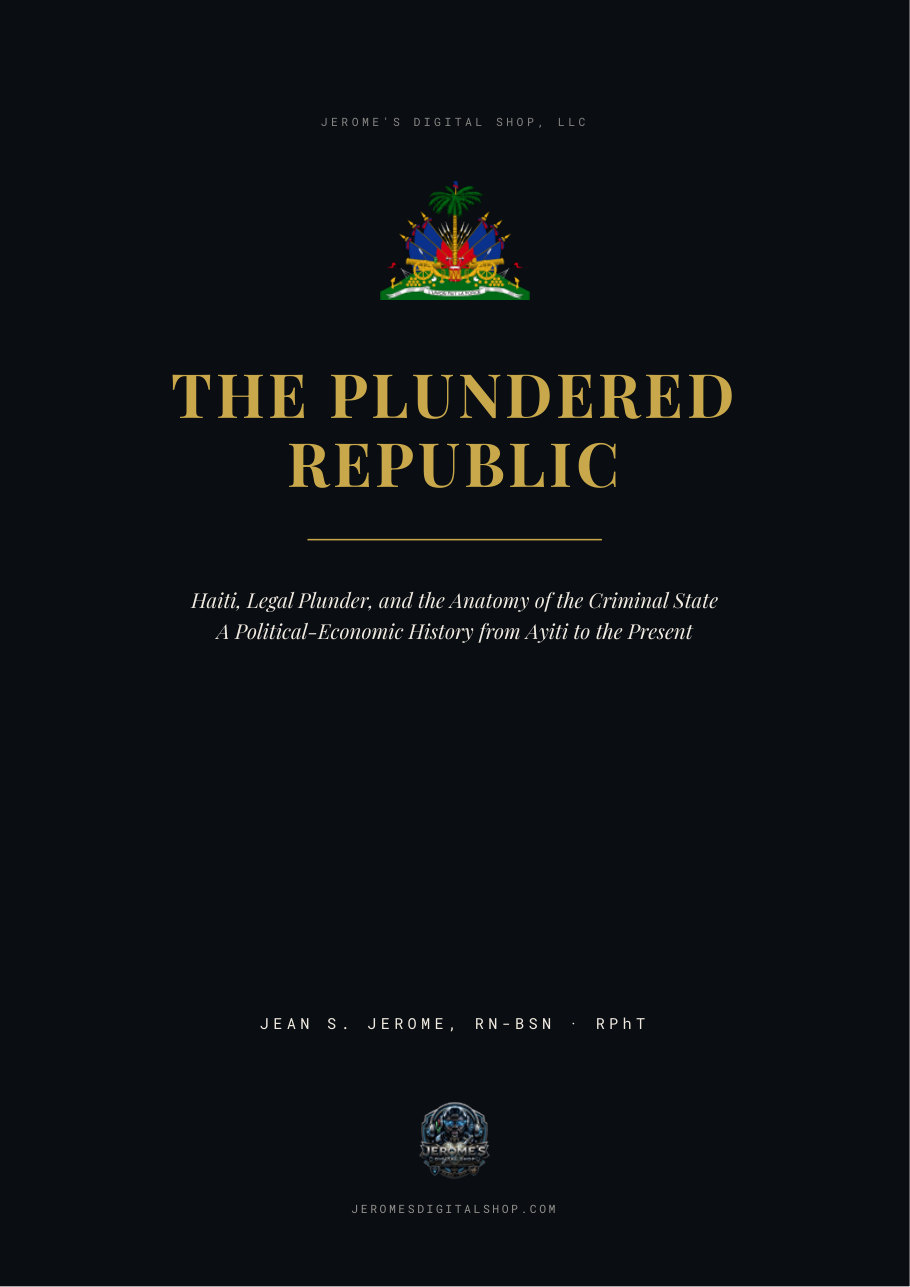
The Plundered
Republic
Haiti, Legal Plunder, and the Anatomy of the Criminal State
$19.99
Ebook
Haiti, Legal Plunder, and the Anatomy of the Criminal State
You've heard the explanations a hundred times — the soil, the people, the curse of history. This book dismantles every one of them.
The same land built Saint-Domingue — the richest colony on earth, producing more wealth than all of Britain's colonies combined. Whatever went wrong, it wasn't the ground under Haitian feet.
Haitians won the only successful slave revolution in human history — defeating Napoleon's armies to do it. A people capable of that is capable of anything. The failure lies elsewhere.
The Dominican Republic shares the same island, the same hurricanes, the same distance from every market. One institution separates them: the secure property of the ordinary individual, protected by objective law.
"The state is the great fiction through which everybody endeavours to live at the expense of everybody else." Nowhere has the fiction cost more than in Haiti.
— Frédéric Bastiat · The Plundered Republic
The first full history of Haiti written through the lens of the great classical liberals — seventeen chapters from the Taíno chiefdoms to the gang catastrophe of today.
From the Code Noir to the coffee tax to the aid-industrial complex — how the law itself became the instrument of theft, generation after generation.
Every planner who tried to run Haiti from above — from the National Palace to a donor conference in New York — and why each one failed for the same reason.
The altruist-collectivist license behind every regime that claimed the Haitian's life for the collective — named, examined, and refuted.
Criminology turned, for once, on the powerful: how institutionalized plunder selects, rewards, and reproduces a sociopathic ruling elite — from the caudillos to the Duvaliers to the gang lords of today.
Taíno Ayiti, Saint-Domingue, the Revolution, the Indemnity of 1825, the American Occupation, the Duvaliers, the Republic of NGOs, PetroCaribe, and the state collapse of today — one continuous story.
Two hundred years of wealth Haiti was prevented from creating — and a concrete, five-point case for what the freest people in the hemisphere's history could yet become.
A genuinely new interpretation — the first full history of Haiti argued through Bastiat, Mises, Hayek, Rand, and Lombroso. Not apology, not despair: a rigorous audit of five hundred years.
Complete and current — seventeen chapters carrying the story all the way to the present: the earthquake, the Republic of NGOs, PetroCaribe, the gang takeover, and the collapse of the state.
The natural experiment nobody talks about — why the Dominican Republic, on the same island, took a different path — and what that proves about institutions, not geography.
Fully referenced — grounded in the scholarship, from Moreau de Saint-Méry to the modern aid literature, with a complete bibliography for readers who want to go deeper.
Two formats included — the reflowable EPUB for any e-reader plus the beautifully typeset PDF edition, exactly as designed. One purchase, both files, instant download.

"The freest people in the hemisphere's history deserve, at last, the freest institutions."
— The Plundered Republic
Five hundred years of plunder, examined with relentless clarity — and the case for liberty that follows from it. Your copy awaits.
Secure checkout via Jerome's Digital Shop • Instant delivery to your device